Blog

The Falcons and the Importance of Premium Picks

The Atlanta Falcons penalty from the NFL for pumping in crowd noise into the Georgia Dome turned out to be a valuable draft pick, but not the “severe” penalty we were all led to discuss.  The team will forfeit their fifth round pick in 2016. With the penalty now known, the Falcons will be able to move forward without the possibility of the NFL taking away a key first, second or third round draft choice.

I’ve always been driven a bit crazy by those that blow off the value of a third round draft choice.  “Who cares, we’ll get the pick wrong anyway”, is the typical excuse used when the idea of trading a third round pick comes up in conversation.  The draft is a crapshoot, and the best way to beat it and regularly come away with talent is to have as many high round draft picks as possible.

For this exercise, let’s take a look at NFL history. Former Dallas Cowboys coach Jimmy Johnson was able to build his team from the worst in the league into a Super Bowl champion in just four seasons. The key wasn’t just hitting on draft picks, but it was the amount that Johnson had given his player trades and moving around the draft board.  From 1989 to 1993, the Cowboys had 24 premium picks.  Premium picks being those that land in the first three rounds.

Look at the amount of premium draft picks the Falcons and team General Manager Thomas Dimitroff had from 2008 to 2012.  The Falcons had 16 premium picks during that time period, which includes the six they held in the 2008 draft. Those picks became the foundation of the current team.

Clearly, that was a different time in the league when Johnson built his champion. But both the 1989 Cowboys and 2008 Falcons were teams that needed as many premium picks as possible to turn the fortunes of the franchise.

Now let’s take a look at how many premium picks the Falcons have had from 2008 to today. That total is 21 picks as we prepare for the 2015 NFL Draft.  Here is how the compares to the rest of the division and various teams around the league:

NFC South:

Atlanta (21)

Tampa (20)

Carolina (18)

New Orleans (16)


NFL:

New England (31)

Detroit (25)

Baltimore (24)

Giants (23)

San Francisco (23)

Green Bay (21)

Philadelphia (21)

Dallas (18)

Seattle (17)
The Falcons Remaining Cap Space

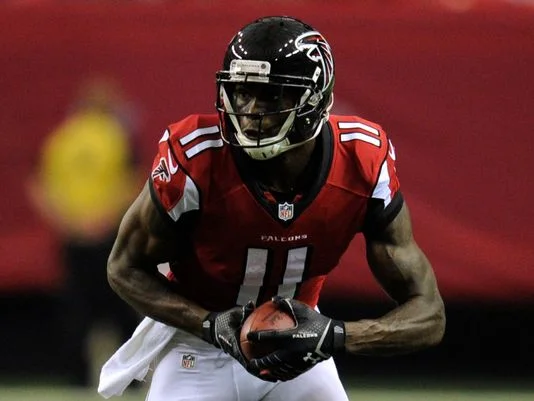
Falcons WR Julio Jones - USA Today

Falcons WR Julio Jones - USA Today

***WARNING, MATH IS HERE. YOU WILL FIND MATH HERE.***


So the Atlanta Falcons have salary cap space.  Actually, some might refer to it as a plethora of cap space.  If you’re in need of a visual representation, the Falcons have a Paul Soliai dinner plate full of salary cap space. Naturally, this also creates frustration for the fan base.

With 23 million dollars available to spend for the 2015 team, minus the rookie salary pool, the Falcons have been shopping in the bargain bin rather than at the luxury car dealership.  As we enter into week two of NFL free agency, the patient approach is wearing thin for a fan base that has seen just 10 wins over the past two seasons. 

But there is a light at the end of the tunnel: The new Julio Jones deal.

The Falcons have the opportunity to use their cap space to provide Jones with the financial security he wants but also protect their future salary cap management.  Trust me; this can be done with a little creativity.  For an example of this, let’s look at the Tampa Bay Buccaneers.

Tampa sucks; let’s acknowledge this right off the bat. But where they hit a home run was with their contract for defensive tackle Gerald McCoy. McCoy received a six year deal that will pay him $95 million dollars over the life of the deal. This is the sort of contract that teams begin to hate when they realize they spent on a position that typically doesn’t warrant big money. But Tampa did this correctly.

Tampa used their available cap space to guarantee a massive base salary in year one of the deal for Gerald McCoy. McCoy’s 2014 base salary was $17 million, which counted entirely in 2014. His $2.5 million dollar signing bonus and various roster bonuses means that McCoy continues to get paid as long as he’s productive but his cap number never reaches $14 million.  That’s smart cap management.

On the other end of the spectrum is defensive tackle Ndamukong Suh’s deal. Because of Miami’s salary cap situation, they will pay Suh a base salary of $985,000 in 2015. His cap number for 2015 is just $6.1 million, but it explodes to $28.6 million in 2016. That’s what happens when you lack cap space and flexibility.

Let’s bring this all back to Julio Jones. The Falcons could use their available space this offseason to emulate the Gerald McCoy deal from 2014. Hypothetically, we’ll say the Falcons wanted to make Jones one of the highest paid receivers in the NFL at $16 million per year on average. Let’s call this a five year deal worth $80 million dollars over the life of the deal.

The Falcons could choose to guarantee Jones’ first year base salary of $22 million and hand him a $10 million dollar signing bonus. With guaranteed roster bonuses of $6 million in 2016 and 2017, the deal would guarantee him $44 million dollars and keep him in the $14.5 million cap hit neighborhood over the life of the deal.  The Falcons would never have to deal with the Calvin Johnson scenario, in which Detroit must deal with cap figures of $20 million in 2015 and $24 million in 2016.

The Falcons have the cap space. Doing a big deal with Julio would still leave them with cap space even after their rookies are signed. The best part of this deal…the Falcons would have around $20 million dollars of cap space again in 2016.

History Repeating to Falcons Benefit?

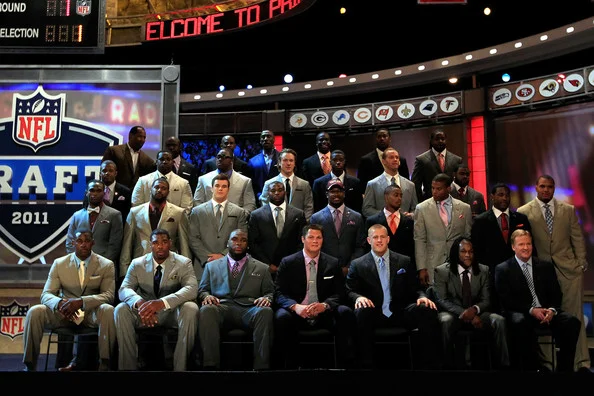
2011 NFL Draft Class

2011 NFL Draft Class

Dante Fowler Jr., Randy Gregory, Shane Ray, Vic Beasley, Bud Dupree...for the Atlanta Falcons the question of what to do with the 8th overall pick in the 2015 NFL Draft is uncomplicated. For a team that hasn't featured a young pass rusher since the days of Patrick Kerney, drafting an impact edge rusher would attack the team's most glaring defensive weakness.

The comparisons for this pass rush class have already been made to the 2011 class. In the 2011 draft, seven edge rushers were taken in the first round. Six of those players have already made at least one pro bowl during the course of their careers.

History repeating itself would be great for the 2015 Falcons draft as we ponder and argue over who to draft. Because most of the teams who took an edge rusher high in the draft in 2011 have been rewarded with outstanding production:


  • 2nd overall - LB Von Miller - Denver Broncos: Has turned in three pro bowl seasons over his four year career. A positive NFL substance abuse test took him off the field for six games in 2013. Thus far has recorded 49 sacks and 13 forced fumbles during his career


  • 7th overall - LB Aldon Smith - San Francisco 49ers: A troubled but very productive player. Has already served a nine game suspension for substance abuse and has had trouble with alcohol. When on the field, Smith has been a destructive force who recorded 33 sacks in his first two seasons. Despite the suspension, Smith has recorded 44 sacks and forced six fumbles thus far.


  • 11th overall - DE JJ Watt - Houston Texans: There is no better defensive player in football right now. Watt is a dominant force who has garnered MVP discussion over his past two seasons. Has taken down the quarterback 57 times thus far in his career along with 12 forced fumbles.


  • 14th overall - DE Robert Quinn - St. Louis Rams: Dropped in the draft due to a childhood brain tumor that concerned some teams. A prototype 4-3 defensive end, Quinn has recorded 45 sacks over his career and forced 14 fumbles.


  • 16th overall - LB Ryan Kerrigan - Washington Redskins: Made the conversion from defensive end to outside linebacker. Had his first double-digit sack season in 2014 after consistently solid numbers to start his career. Has now recorded 38 sacks and forced 15 fumbles in his four year career.